McKinney, TX
East along the tollway, from the historic square to Stonebridge Ranch.

North Dallas Growth Corridor Repair
Frisco sits about twelve miles northwest of Plano, and it is the newest big city in the area. Most of its homes went up in the last twenty years, in master-planned neighborhoods with young trees and wide streets. The houses are new, but the ground underneath them is the same old clay, and the lots were graded and filled before the first brick was laid.
The most common Frisco call starts with a stair-step crack in the brick of a two-story home. The crack usually runs through the mortar near a corner, often starting at a second-floor window, and it shows up after a dry summer when the clay has shrunk the most. The slab underneath is usually a post-tension slab, poured in the 2000s or 2010s, and it is strong in tension but still rests on clay that moves. When one corner of the lot dries out faster than the rest, that corner drops, and the brick at the corner is where the stress shows.
Garage separation is the second common fix. The garage slab is poured apart from the house slab, so it settles on its own schedule, and the gap at the doorway between the garage and the house tells you how far it has dropped. On a newer home, that gap can open within the first few seasons as the fill under the garage compacts. It is a separate slab with a separate fix, and it is worth checking at the same time as the house.
Drainage problems show up on the graded lots that Frisco is built on. A swale that was meant to carry water away from the house can fill in over a few seasons, a downspout can dump at the foundation, or a patio can settle toward the house instead of away from it. Any of those soaks one side of a slab while the other side stays dry, and that uneven moisture is what makes one corner move. Our guide to how drainage protects your foundation explains the grading and gutter fixes that matter most on a new lot.
Cracks in driveways and patios are the fourth common call. Those slabs are thinner than a house slab and sit on the same fill, so they show settlement first. A driveway section that has dropped, or a patio that slopes toward the back door, is often fixed with lifting rather than piers, and our concrete lifting and leveling page covers that work. When the house slab itself has moved, the fix is piers, and our steel pier installation page covers that method.
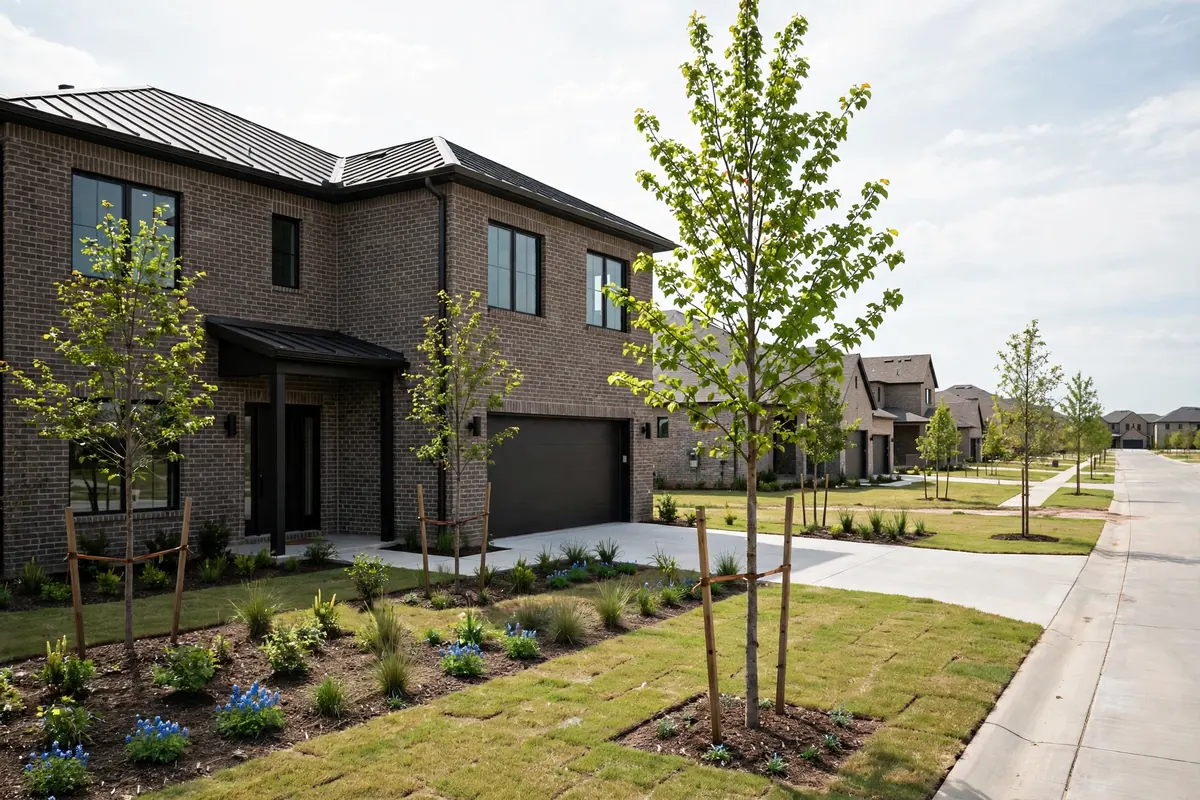
Almost every Frisco home is a two-story brick home on a post-tension slab, built in a master-planned community. Phillips Creek Ranch, Starwood, Stonebriar, Newman Village, Richwoods, Frisco Lakes, Hollyhock, and Panther Creek each have their own builders, their own floor plans, and their own grading, but they share the same pattern: a large home on a graded lot, with a garage, a patio, and a yard that was shaped by machines before the house went up.
Cut-and-fill grading is the part owners rarely hear about. A lot that slopes is cut on one side and filled on the other, so the house ends up sitting half on undisturbed clay and half on engineered fill. The fill compacts over the first few seasons, and the clay underneath still swells and shrinks with the weather. A home that sits on that boundary can settle unevenly, with one side dropping a little while the other side holds. That is why a crack in a five-year-old Frisco home is not unusual, and why it is worth measuring rather than dismissing.
The trees are young, which changes the picture for now. A young tree does not pull as much water out of the clay as a mature oak, so tree roots are a smaller cause in Frisco than in older suburbs. That will change as the trees grow, and the homes near the greenbelts and trails will feel it first. For now, the causes that matter most are grading, fill, and drainage, and the inspection looks at those before anything else.
Older Frisco still exists, around the Rail District and Frisco Square, where the original town grew up along Main Street. Those homes are older and smaller, some on pier and beam, and they need a different eye. Our guide to pier and beam vs slab foundations explains the difference, and our pier and beam foundation repair page covers the older homes.
A crack in a young home is worth measuring. Book an inspection and get the readings before it grows.
The first factor is how many piers the elevation map calls for. A slab that has dropped at one corner needs fewer piers than a slab that has settled along a whole side. The map comes from floor readings taken room by room, and it is what the plan is built on. A foundation inspection gives you that map before any work starts, so the scope follows measurements instead of guesses.
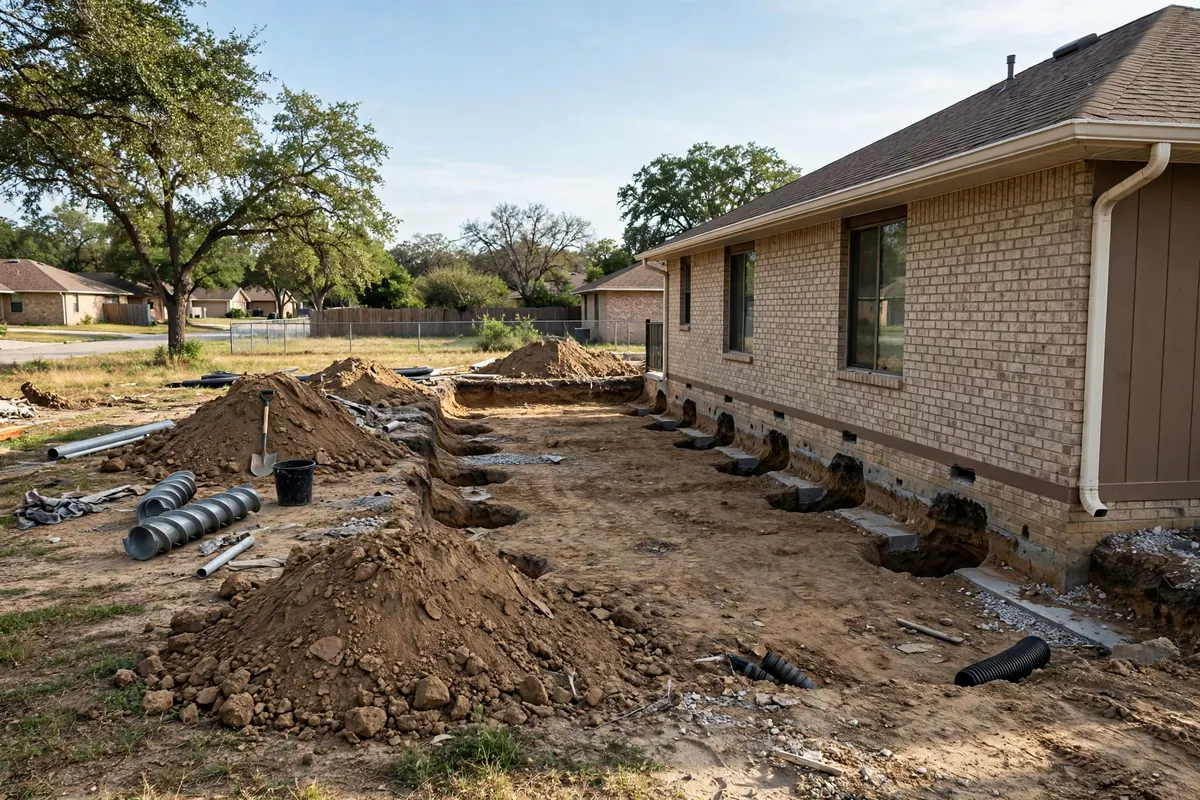
The second factor is access. A pier goes in beside the footing, which means a small excavation at each pier point. Patios, decks, air conditioning units, and landscaping can all sit over a pier point, and working around them takes more care. A home with a clear footing line is simpler to work on than one where the footing is buried under a built-out patio.
The third factor is drainage. If the lot is holding water against the house, the repair needs drainage work alongside the piers, or the clay will keep moving after the piers are in. That can mean re-grading a bed, moving a downspout, or adding a French drain along the side where water collects. Our drainage correction page covers that work, and our foundation crack repair page covers the cracks that come with the movement.
The fourth factor is the slab type. A post-tension slab has cables running through it, and the pier work has to respect them. The lift is done in small steps while the readings are watched, and the doors and windows are checked as the slab moves. A home that needs leveling as well as support is covered on our house leveling and lifting page, and the method is the same slow, measured lift.
Frisco covers four main ZIP codes. The 75033 side holds the west side, with Phillips Creek Ranch, the Trails of West Frisco, and the newer building toward the PGA Frisco campus. The 75034 side holds the central city, with Stonebriar, Frisco Square, the Rail District, and the Star district. The 75035 side holds the east side, with Richwoods, Panther Creek, and the neighborhoods along Preston Road. The 75036 side holds the north side, with the Fields community and the newest subdivisions.
The neighborhoods each have their own character. Phillips Creek Ranch has lakes, trails, and a fitness center, with homes from the 2010s. Starwood is a gated community with custom homes and its own security. Stonebriar is one of the oldest master-planned communities in Frisco, with established trees and a golf course. Newman Village has European-style architecture and semi-custom homes. Frisco Lakes is a 55-plus community with its own golf course and amenity centers. Hollyhock and Richwoods are newer, with energy-efficient builds and young trees.
The roads that tie Frisco together are the Dallas North Tollway, the Sam Rayburn Tollway, Preston Road, Main Street, Eldorado Parkway, and Warren Parkway. The landmarks owners use to place a street are the Star, the PGA Frisco campus, Toyota Stadium, Stonebriar Centre, Frisco Square, and the Rail District. If your home sits near one of those, we know the streets around it.
We work across all four Frisco ZIP codes, and across the border into McKinney to the east, Allen to the southeast, and The Colony to the south, so a home near the city line is covered the same as one in the middle of town.
| Neighborhood | ZIP | What to know |
|---|---|---|
| Phillips Creek Ranch | 75033 | Master-planned community with lakes, trails, and a fitness center. |
| Starwood | 75034 | Gated community with custom homes and private security. |
| Stonebriar | 75034 | One of the oldest master-planned areas, with a golf course and mature trees. |
| Newman Village | 75033 | Semi-custom homes with European-style architecture. |
| Richwoods | 75035 | Newer east side homes near Preston Road. |
| Frisco Lakes | 75034 | 55-plus community with a golf course and amenity centers. |
| Hollyhock | 75033 | Newer west side homes with energy-efficient builds. |
| Panther Creek | 75035 | East side neighborhood near Panther Creek and the trails. |
| Fields | 75036 | Newest north side community near the PGA Frisco campus. |
| The Trails of West Frisco | 75033 | Established west side streets with trails and a golf club. |
A small crack in a new home can be normal settling as the fill under the lot compacts. A hairline crack that looks the same month after month is usually settling. A crack that widens, runs in steps through the brick, or shows up alongside a sticking door points to movement that is still active, and that is when floor readings are worth having.
The garage slab is poured apart from the house slab, on its own base, and the fill under it compacts in the first few seasons. The slab drops a little, and the slope follows the lowest point. A garage slab that has dropped can often be lifted back, and it is worth checking at the same time as the house, because the same clay and fill are moving under both.
Not yet, for the most part. A young tree does not pull much water out of the clay, so tree roots are a smaller cause in Frisco than in older suburbs with mature oaks. That will change as the trees grow, and the homes near greenbelts and trails will feel it first. For now, grading, fill, and drainage are the causes that matter most on a Frisco lot.
Most Frisco lots were graded before the homes went up, and a lot that slopes was usually cut on one side and filled on the other. The signs are in the house: settlement on one side, a crack at the corner on the fill side, or a patio that slopes toward the house. An inspection can confirm it from the elevation map and the grading around the lot.
Yes. The west side around the PGA Frisco campus holds some of the newest building in the city, and new homes sit on graded fill that settles in the first few seasons. The clay underneath is the same ground as the rest of Frisco. A small crack in a three-year-old home is worth a reading, because early settlement is simpler to correct than movement left for years.
Last updated November 24, 2026
Call or book an inspection and we will map your floors, check the grading, and lay out the options.