The Colony, TX
North along the tollway, on the shore of Lake Lewisville.
Three-County Foundation Repair
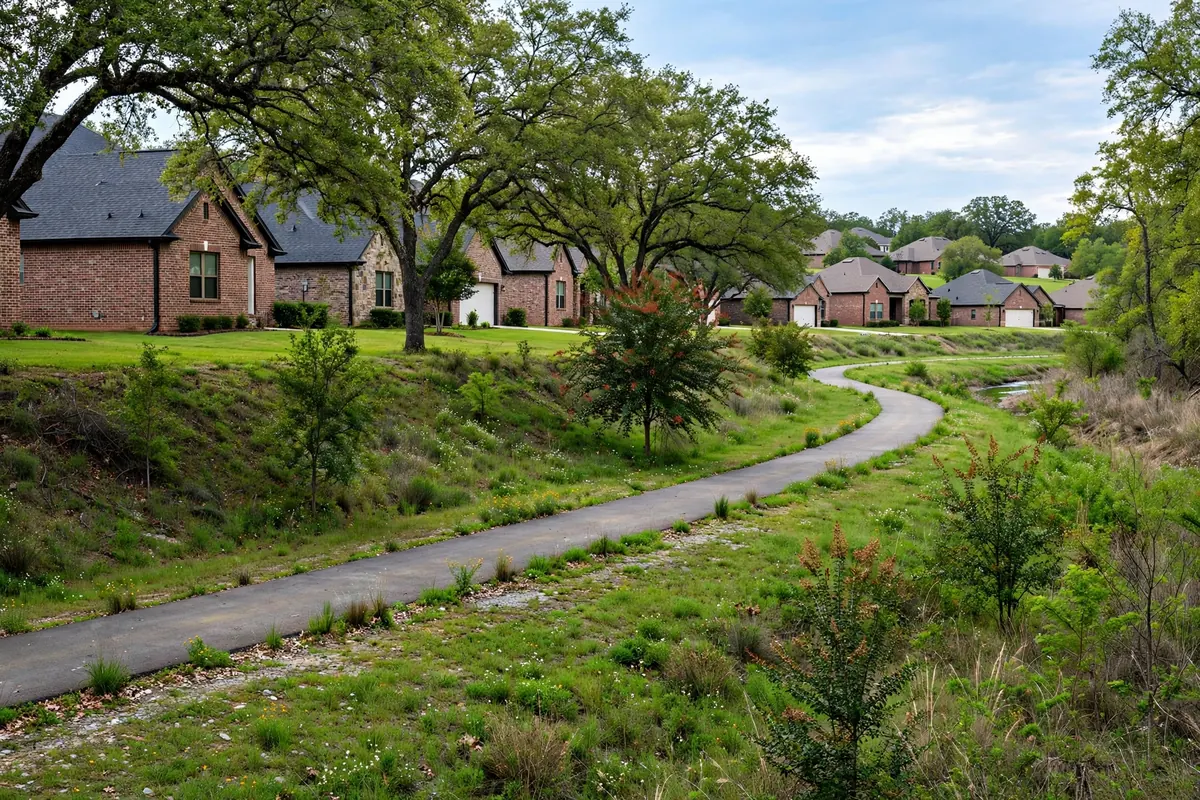
Carrollton sits about fourteen miles southwest of Plano, spread across three counties and crossed by I-35E, the Bush Turnpike, and the Dallas North Tollway. It has a historic downtown square, DART rail stops, greenbelts along its creeks, and housing that runs from 1970s two-stories to newer townhomes along the Hebron corridor, all of it on the same moving clay.
Carrollton is not one housing market, and the foundation work shows it. Downtown and south-central Carrollton, in the 75006 ZIP code, holds the historic square, older bungalows, mid-century homes, and newer townhomes near the DART stations. The homes near the square are the oldest in the city, and some of them sit on pier and beam foundations with crawl spaces underneath. The streets between I-35E, Belt Line Road, and Josey Lane carry older ranches and two-stories, with real variation in how they were built and how they have aged.
Central and north Carrollton, in the 75007 ZIP code, is the classic suburb: Indian Creek, Rosemeade, and the streets around them, with established neighborhoods, parks, mature trees, and lots of 1980s and 1990s two-story brick homes. These are slab homes, mostly conventional slabs from the era before post-tension work became standard, and they have had thirty or forty seasons of wet and dry to show movement in their walls and floors.
Northwest Carrollton, in the 75010 ZIP code, is the newer side, along the Hebron Parkway corridor near the Bush Turnpike and the Sam Rayburn Tollway. The homes here are generally newer than central Carrollton, with larger floor plans and newer townhomes, and the lots were graded for the development. Coyote Ridge and Austin Waters hold larger homes on the northwest side, and the Castle Hills edge sits just over the line in Lewisville.
All three parts sit on the same Blackland Prairie clay, and the same shrink-swell cycle moves every slab in the city. What changes is the age of the slab, the type of foundation, and the grading of the lot. Our guide to pier and beam vs slab foundations explains the two types, and our foundation inspection looks at which type your home has and how it is moving.
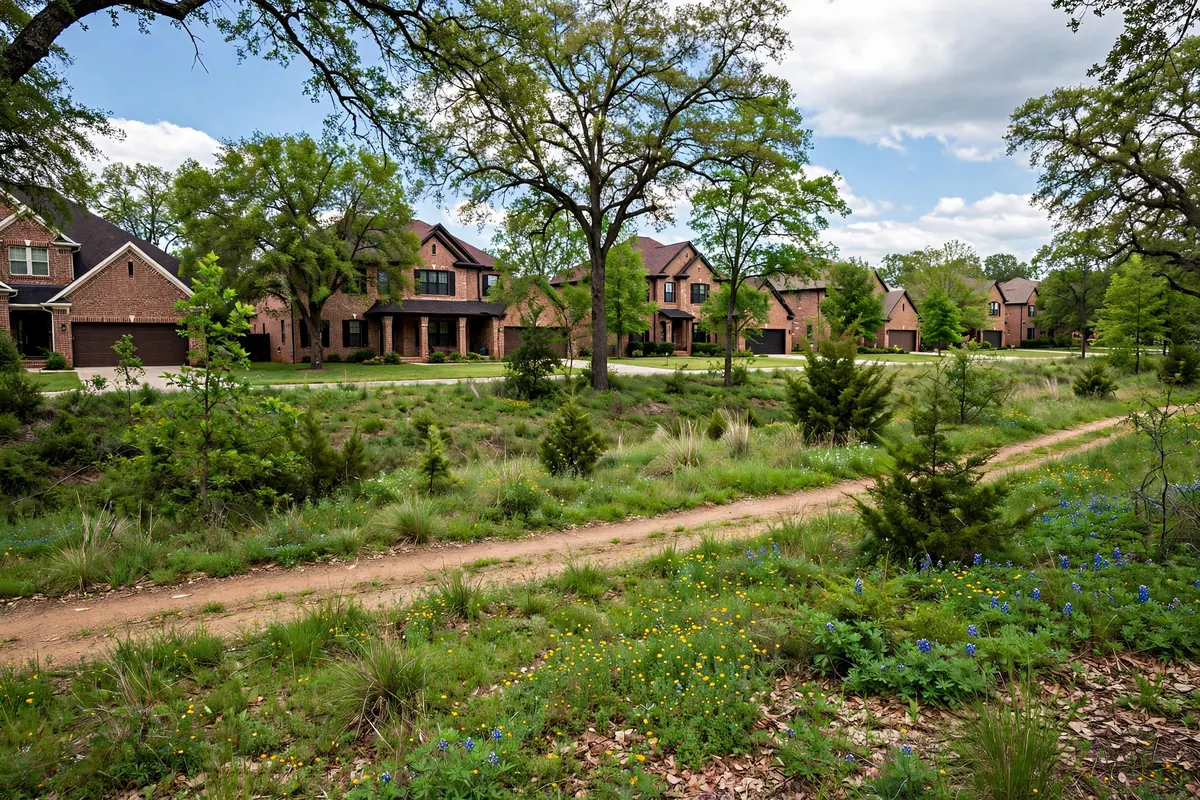
Creek-side moisture is the first Carrollton cause. Furneaux Creek, Indian Creek, and the greenbelts that run through the city keep the ground damp on one side of a lot while the other side dries out. That uneven moisture is what makes one corner of a slab move while the rest holds. A home near a greenbelt or a creek often shows its first crack on the side nearest the water, and the fix usually includes drainage work on that side. Our guide to how drainage protects your foundation covers the grading and gutter fixes that matter most on a creek-side lot.
Tree roots are the second cause, and Carrollton has plenty of them. The greenbelts are lined with oaks and pecans, and a large tree near a corner can pull enough water out of the clay in a dry summer to drop that corner by itself. The effect is strongest on the sunny side of a house, where the soil dries out fastest. When the roots are the cause, a root barrier between the tree and the house can slow the drying, and it is often done alongside pier work on the same corner. Our guide to tree roots and your foundation explains how roots move a slab.
Stair-step cracks in the brick are the third common call, especially on the 1980s and 1990s two-stories in Indian Creek and Rosemeade. The crack follows the mortar joints near a corner, often starting at a second-floor window, and it shows that one part of the slab has settled while the rest holds. Our guide to how to tell if a foundation crack is serious walks through which cracks to watch and which ones to act on, and our foundation crack repair page covers the repair itself.
Doors that stick, floors that slope, and gaps at the baseboards round out the list. They are the signs owners notice inside the house, and they usually go with the same corner movement that cracks the brick outside. One sign on its own does not always mean a repair is needed, but several signs on the same corner, or signs that keep getting worse through a dry summer, point to movement that is still going on.
Start with an inspection: floor readings, a written plan, and a straight answer about what your home needs.
It starts with an inspection. We walk the outside of the house first, looking at the brick, the grade, the gutters, the greenbelt or creek on the lot line, and where the big trees stand. Then we take floor elevation readings inside, room by room, and map the high and low points of the slab. That map is what the repair plan is built on, and it is what we show you before any work starts. Our guide to what a foundation inspection covers walks through the visit step by step.
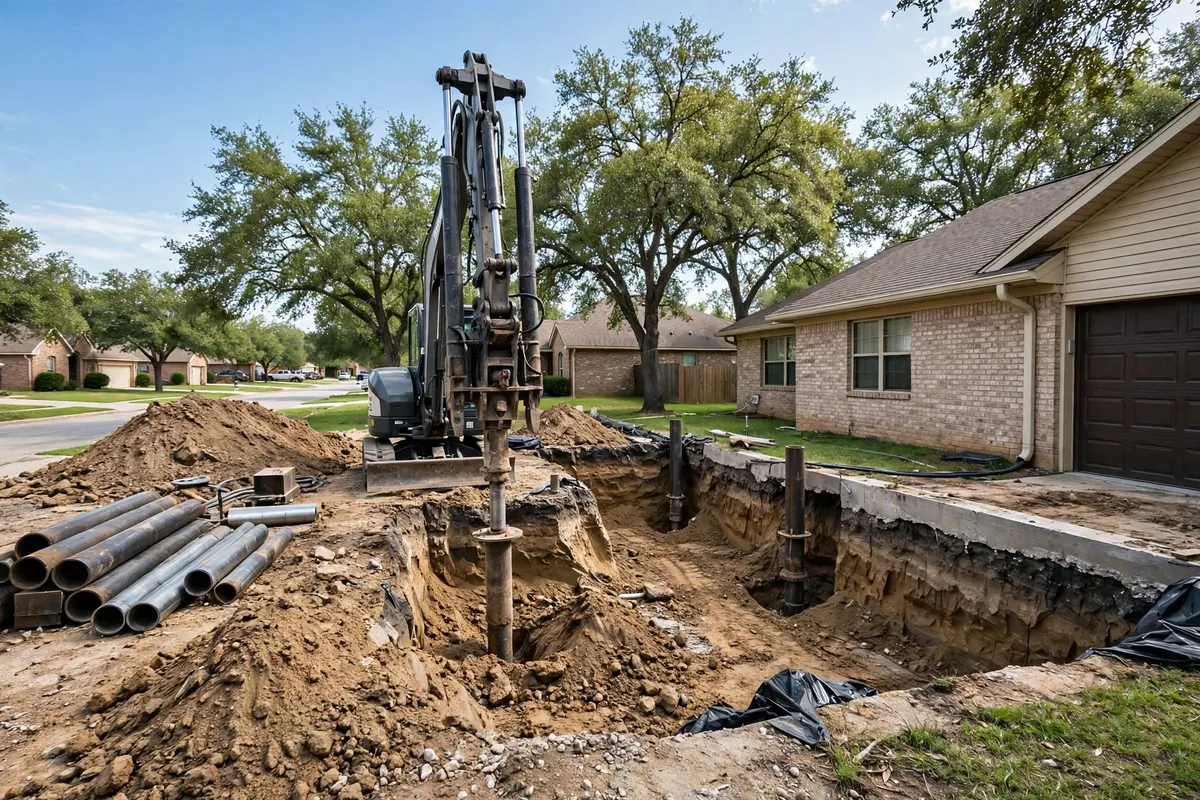
If piers are needed, they go in beside the footing at the points the elevation map calls for. Each steel pier is driven down to firm, load-bearing ground, a bracket is set under the footing, and the home is lifted back toward level in small steps while we watch the readings. The lift is slow on purpose: a slab that has settled over years is brought back a little at a time, and the doors and cracks are checked as it moves. The method is the same one on our steel pier installation page, and the slab side of it is on our concrete slab foundation repair page.
On a pier and beam home near downtown, the work happens in the crawl space: failed piers are replaced, beams are shimmed and re-leveled, and moisture problems are dealt with so the repair holds. That work is on our pier and beam foundation repair page. On a slab home, the drainage work usually follows the piers, so the clay around the house stays even after the repair. Our drainage correction page covers that work.
We finish with a walkthrough. The doors and windows you pointed out at the start get checked again, the cracks get measured again, and you get the elevation readings from before and after, so you can see the change in numbers rather than taking our word for it.
Carrollton covers three main ZIP codes. The 75006 side holds downtown and south-central Carrollton, with the historic square, the Josey Ranch Lake area, and the established streets between I-35E, Belt Line Road, and Josey Lane. The 75007 side holds central and north Carrollton, with Indian Creek, Rosemeade, and the neighborhoods around Trinity Mills. The 75010 side holds northwest Carrollton and the Hebron corridor, with Coyote Ridge, Austin Waters, and the newer townhomes near the Bush Turnpike and the Sam Rayburn Tollway.
The neighborhoods each have their own feel. Josey Ranch has the lake, the library, and established streets around them. Indian Creek has greenbelts, ponds, and golf course proximity. Rosemeade has parks, the aquatic center, and everyday retail close by. Coyote Ridge and Austin Waters have larger homes on the northwest side. The Country Place and Woodlake are tree-lined streets with pocket parks. Furneaux Creek runs through the east side with its own greenbelt.
The roads that tie Carrollton together are I-35E, the Bush Turnpike, the Sam Rayburn Tollway, the Dallas North Tollway, Josey Lane, Belt Line Road, Hebron Parkway, and Keller Springs Road. The landmarks owners use to place a street are the historic downtown square, Josey Ranch Lake, Indian Creek Golf Club, Trinity Mills Station, Downtown Carrollton Station, and the A.W. Perry Homestead Museum. If your home sits near one of those, we know the streets around it.
We work across all three Carrollton ZIP codes, and across the border into The Colony to the north and Addison to the southeast, so a home near the city line is covered the same as one in the middle of town.
| Neighborhood | ZIP | What to know |
|---|---|---|
| Josey Ranch | 75006 | Established streets around Josey Ranch Lake and the library. |
| Downtown Carrollton | 75006 | The historic square with older bungalows and newer townhomes nearby. |
| Furneaux Creek | 75006 | East side streets along the Furneaux Creek greenbelt. |
| Indian Creek | 75007 | Established neighborhood with greenbelts, ponds, and golf proximity. |
| Rosemeade | 75007 | Family streets near the Rosemeade Rainforest aquatic center and parks. |
| Trinity Mills | 75007 | Corridor around the Trinity Mills DART station and I-35E. |
| Coyote Ridge | 75010 | Larger homes on the northwest side near the Hebron corridor. |
| Austin Waters | 75010 | Established northwest community with larger homes. |
| The Country Place | 75007 | Tree-lined streets with pocket parks in central Carrollton. |
| Woodlake | 75007 | Established neighborhood near the lakes and trails. |
It can. A creek or greenbelt keeps the ground damp on one side of a lot while the other side dries out, and that uneven moisture is what makes one corner of a slab move while the rest holds. Homes near Furneaux Creek and Indian Creek often show their first crack on the side nearest the water. An inspection can show whether the damp side has already dropped.
The 1980s and 1990s two-stories in Indian Creek and Rosemeade carry a lot of weight on conventional slabs, and their corners sit at the edge of the slab where the clay dries out first. When one corner drops, the wall above it is pulled down at that corner, and the mortar cracks in steps as the wall flexes.
It can slow the drying that a large tree causes. A root barrier is a rigid panel set in a trench between the tree and the house, and it keeps the roots from pulling water out of the clay right beside the footing. It works best alongside pier work on the same corner, so the slab is supported while the clay stays even.
Walk the brick outside and look for stair-step cracks, then check every door and window inside for sticking or gaps. Ask for floor elevation readings as part of the inspection, and look at the gutters and grading to see where water goes in a storm. A home near the square may be pier and beam rather than slab, so ask which type it is.
Yes. The Hebron corridor holds newer townhomes on graded lots, and the fill under them settles in the first few seasons just like anywhere else in Carrollton. The clay underneath is the same ground as the older streets near downtown. A small crack or a sticking door in a new townhome is worth a reading, because early settlement is simpler to correct.
Last updated November 24, 2026
Call or book online and we will check the grade, the drainage, and the floors, then lay out the options.