Drainage protects your foundation by keeping the clay under your house evenly moist, instead of soaked on one side and dry on the other. When rainwater runs away from the walls, the soil swells and shrinks in balance, and the foundation stays steady through wet springs and dry summers.
By Plano Foundation Repair · Last updated November 24, 2026
When water pools against a wall, the clay on that side swells and lifts, and the foundation bends. This guide covers the gutters, grading, and drains that keep water moving the right way, and the simple seasonal check that catches problems early.
The City of Plano publishes homeowner guidance on grading and drainage around a house, which is a useful reference for the slope and the soil line in this guide.
How water finds its way to your foundation
Rainwater reaches a foundation by the shortest path the ground gives it. A roof sheds water into gutters, the gutters carry it to the downspouts, and the downspouts put it on the ground. From there the slope of the soil decides where it goes. If the soil slopes away from the house, the water runs off into the yard and the street. If the soil slopes toward the house, or sits flat beside the wall, the water pools against the concrete and soaks into the clay there.
The pool is the problem. Clay beside a wet foundation swells and lifts, while the clay on the dry side of the house stays put, and the foundation bends between the two. The bend shows up as a stair-step crack in the brick on the wet side, a door that sticks after a storm, or a floor that slopes toward the dry side. Why Plano's clay soil cracks foundations explains the soil cycle behind the bend, and foundation problems after heavy rain in Plano covers what a wet season does to the ground.
Water also arrives from below. A plumbing leak under a slab, a sprinkler line that runs too close to the wall, or a flower bed watered daily on one side of the house all soak the clay in one place. The source is different, but the result is the same: uneven moisture and a foundation that moves.
Gutters, downspouts, and where the water lands
Gutters are the first line of defense, and they only work when they are clean. A gutter full of leaves overflows at the lowest point, and the overflow falls straight down beside the foundation, exactly where the water should never land. Clean the gutters twice a year, in late fall after the leaves drop and in spring before the storm season, and check them after any big storm that drops branches on the roof.
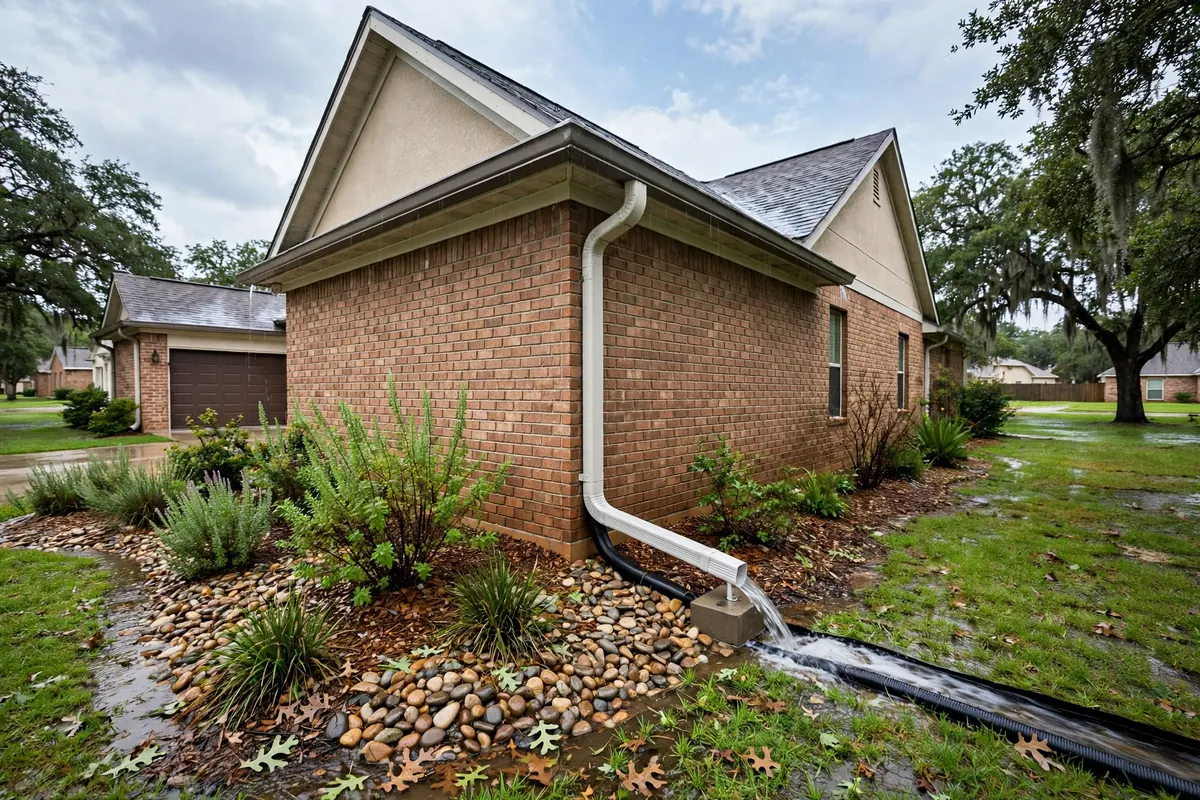
Downspouts decide where the water lands. A downspout that ends at the wall dumps the whole roof's water in one spot, and that spot becomes the wettest clay around the house. An extension that carries the water several feet from the wall, or a buried line that runs it to the street, spreads the load and keeps the soil beside the foundation dry. Check every downspout after a rain and look for the wet patch where it ends. If the patch sits against the wall, the extension is too short. Drainage correction covers the downspout and grading fixes that move water away from a house.
The roof itself matters too. A valley that pours water onto one corner, or a gutter that sags and spills at a joint, can soak one section of foundation while the rest of the house stays dry. Walk the house during a rain, if you can do it safely, and watch where the water actually goes. The real path is often different from the planned one.
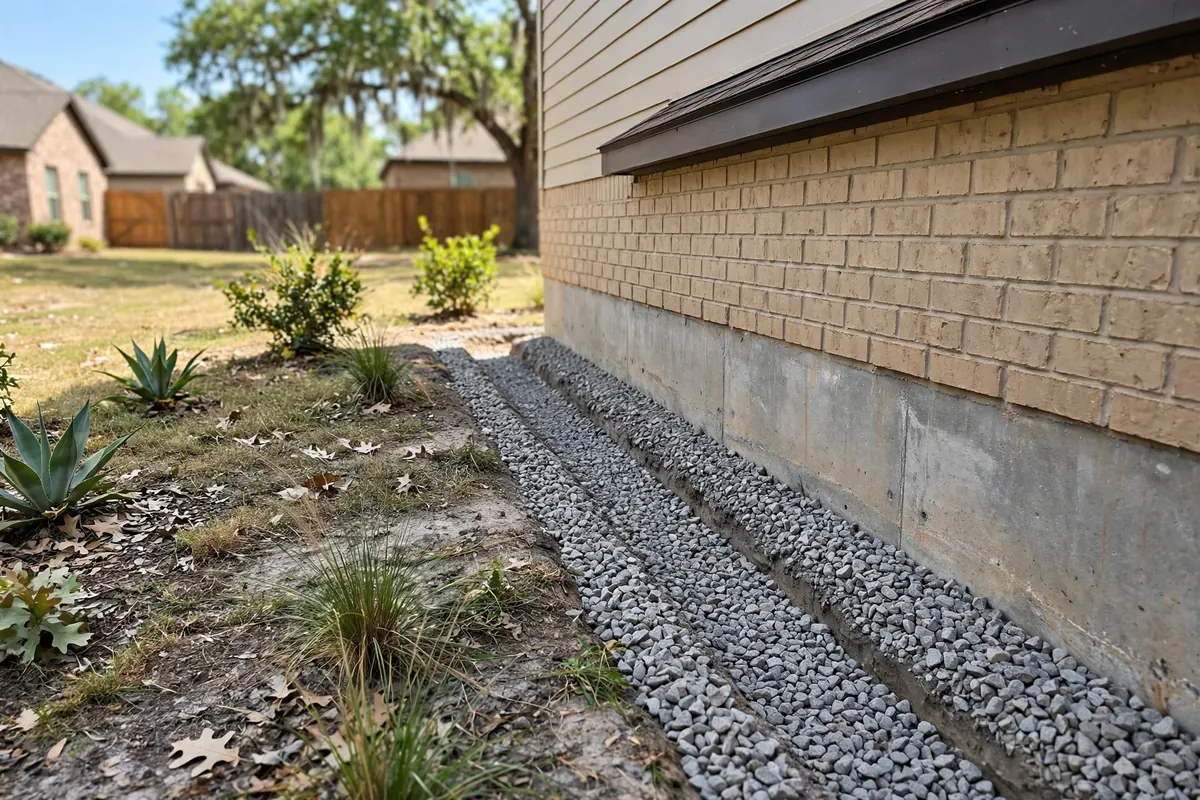
A closer look. French drain with gravel beside a house foundation.
Grading soil so it slopes away from the house
Grading is the slope of the soil around the house, and the rule is simple: the ground should fall away from the wall for the first several feet, so rainwater runs off instead of pooling. New homes are graded that way, but the soil beside a house settles over the years, and the slope flattens or reverses. A low spot beside the wall becomes a pool after every rain, and the pool becomes the wet side of the clay cycle.
Fixing the grade around the house
Fixing the grade is straightforward work. Add soil to the low spots beside the wall, shape it so it falls away from the house, and keep the soil line below the brick line, so water cannot reach the siding. Do not pile soil against the brick, and do not let mulch hold water against the wall. The City of Plano publishes homeowner guidance on grading and drainage around a house, which is a useful reference for the slope and the soil line.
Check the grade once a year, in spring, when the soil is soft and the low spots show. A wheelbarrow of soil and an hour of work can restore a slope that has settled over five years, and that hour is one of the best investments a Plano homeowner can make in their foundation.
Not sure what you are seeing?
An inspection measures the floors and the brick, so you get readings and a written plan instead of guesses. Call (972) 430-3826 or book an inspection.
French drains and surface drains explained
A French drain is a trench filled with gravel and a perforated pipe, buried along the side of a house where water collects. Rainwater soaks into the gravel, enters the pipe through its holes, and runs along the pipe to a safe outlet, usually the street or a low corner of the yard. The drain works underground, so it suits a side yard that pools after every storm but looks dry between rains. The pipe needs a steady fall along its length, and the outlet needs to stay clear, or the drain will hold water instead of moving it.
A surface drain, sometimes called a channel drain, sits at ground level across a driveway or a patio where water runs in a sheet. The grate catches the water and the pipe below carries it away, which keeps a low driveway from sending its water against the garage wall. Surface drains suit hard surfaces, and French drains suit soil, and a house with both problems may need both. Drainage correction explains which drain fits which problem, and the crew that installs one should also check the gutters and the grade, because a drain cannot fix a downspout that dumps water beside the wall.
Drains are not a fix for a foundation that has already moved. They are a fix for the water that moved it, and they work best alongside the structural repair, so the piers or the leveling are not tested by the same water every season.
Drainage fixes and the problems they solve
Fix
Problem it solves
Where it fits
Clean gutters
Overflow falling beside the wall
Every house, twice a year
Downspout extension
Roof water dumped at a corner
Any downspout ending at the wall
Regrading
Low spots pooling against the wall
Soil that has settled beside the house
French drain
Water collecting along a side yard
Yards that pool after storms
Surface drain
Water sheeting across a driveway
Low driveways and patios
What it looks like. Re-graded yard sloping gently away from a house.
A simple seasonal drainage check
Walk the house four times a year, once each season, and the check takes about twenty minutes. In spring, look for low spots beside the walls after the rains, and check that the gutters run clear. In summer, look for the gap where dry clay has pulled away from the foundation, and water the ground evenly if the gap is wide. In fall, clean the gutters after the leaves drop, and check the downspout extensions before the winter storms. In winter, watch where the water goes during a storm, and note any pool that forms beside the wall.
Write down what you find, because a pool that appears in the same spot every spring is a pattern, and a pattern is a plan. A French drain, a regrade, or a longer downspout extension are all small jobs compared with a pier job, and they are the jobs that keep a pier job from being needed again. Foundation maintenance tips for Plano homeowners lists the seasonal habits that keep a house steady, and drought and foundation damage in Plano covers the dry side of the same cycle.
The check costs nothing but time, and it catches the water problems while they are still small. A homeowner who knows where the water goes is a homeowner whose foundation has a fair chance.
Drainage questions from Plano homeowners
Three questions Plano homeowners ask us most, answered in plain words.
?
How far should a downspout carry water from the house?
Far enough that the water lands on ground that slopes away from the wall, usually several feet out. A downspout that ends at the wall dumps the whole roof's water in one spot, and that spot becomes the wettest clay around the house.
?
Do I need a French drain, or will regrading fix it?
Regrading fixes a low spot beside the wall, and a French drain fixes water that collects along a side yard and has nowhere to go. Many houses need both, and the inspection shows which problem is yours. A downspout that stops at the wall can also be the whole problem, and an extension may fix it without either job.
?
Can bad drainage cause foundation problems on its own?
Yes. Uneven water is one of the main drivers of clay movement in Plano, and a house with a downspout at one corner and dry soil everywhere else can show cracks on the wet side within a few seasons. Fixing the water first is often the cheapest repair, because the clay steadies once the moisture evens out.
Related guides
More reading on the same ground, written for Plano homeowners.