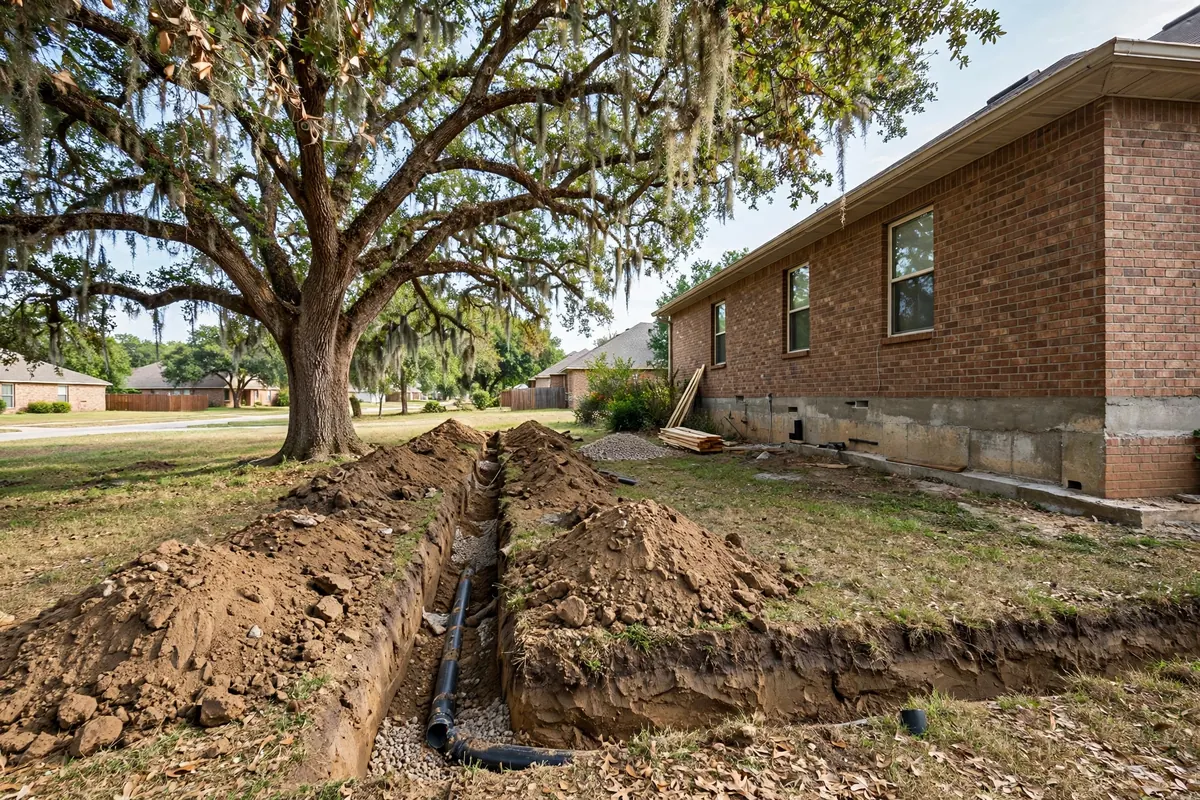
Root Barrier Installation in Plano, TX
A large oak is a fine thing to have near a house until its roots start drinking from the clay under one corner of the foundation. That corner dries, shrinks, and drops while the rest of the house stays put, and the brick above it cracks in a stair-step pattern that points straight at the tree.
How a root barrier protects a Plano foundation
A root barrier does not fight the tree. It changes where the roots can go, so the soil under the house stays evenly moist.
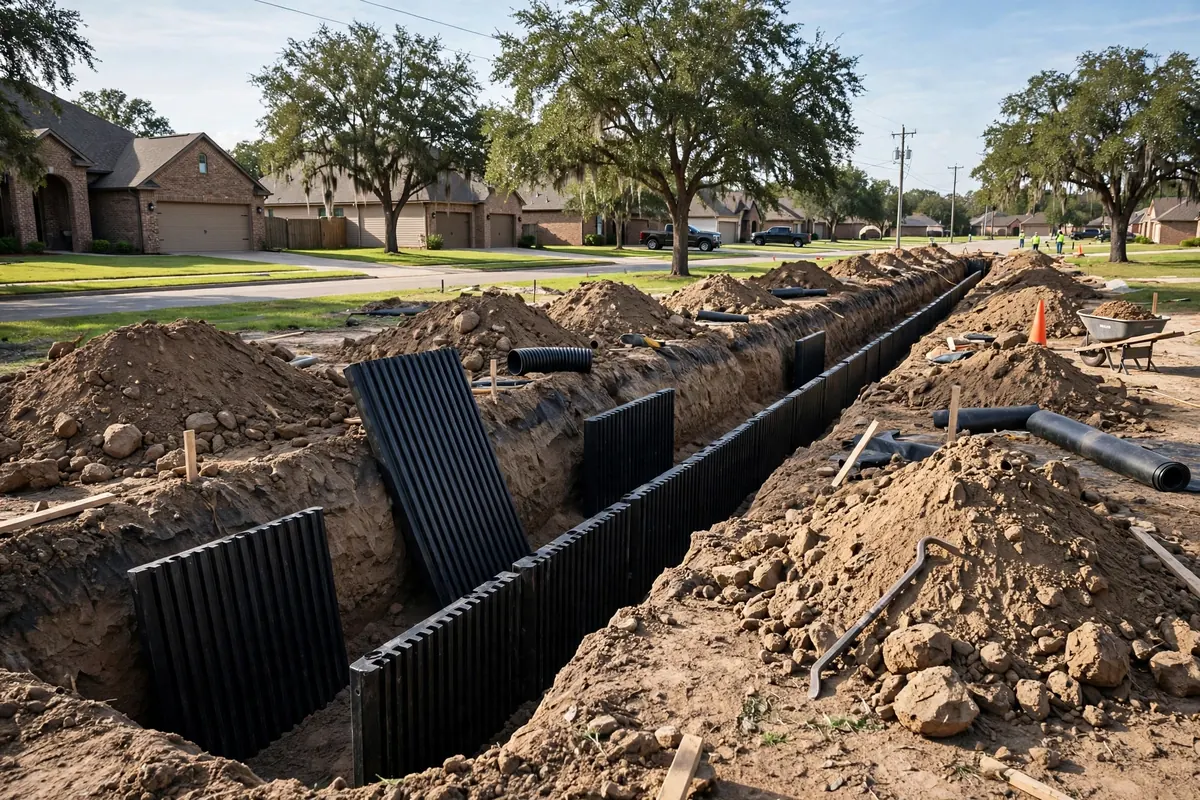
A root barrier is a rigid panel set upright in a trench between a tree and a house. The panel runs from near the surface down below the root zone, usually deep enough that the feeder roots of a mature oak or pecan meet the panel and turn downward instead of spreading sideways toward the foundation. Roots follow moisture, and the panel removes the easy path under the house. The soil under the foundation then dries and swells more evenly, because no single tree is pulling water from one corner alone.
The barrier works with the clay, not against it. Plano clay swells when wet and shrinks when dry, and a foundation moves when one side of it experiences a different moisture level than the other. A large tree can create exactly that difference: the ground under its canopy dries out in summer while the shaded side of the house stays damp. The panel evens the draw by forcing roots to drink from deeper soil, where the moisture changes more slowly through the seasons. The tree itself stays healthy, because its deeper roots still reach water, and the canopy above does not have to be cut back.
A barrier is not a wall around the whole house. It is placed on the line between the tree and the foundation, and its length and depth are set by the size of the tree, the distance to the house, and the soil. A small ornamental tree close to a wall needs a short, shallow panel; a mature live oak twenty feet from a corner needs a longer, deeper one. A foundation inspection with elevation readings shows whether the movement lines up with the tree, because root-related movement is usually worst on the side nearest the canopy. The Texas A&M AgriLife Extension Service publishes guidance on trees and soil moisture that we use when planning around mature trees. See the full list of foundation repair services in Plano for how a barrier fits beside pier work and drainage.
Barriers are usually made from rigid high-density panels that join into a continuous run with no gaps at the seams. The top edge sits just below the surface so a mower passes over it, and the bottom edge sits deep enough that roots cannot slip underneath. Where a barrier crosses a utility line or a sprinkler pipe, the panel is cut and sealed around it rather than forced through. The trench is backfilled with the same soil, compacted in layers, so the ground settles evenly and the lawn can be restored over it.
Signs a tree is pulling moisture from under your home
Root damage looks like foundation movement, and the tree is the clue that sets it apart.
The clearest sign is a pattern: cracks and movement on the side of the house nearest a large tree, while the far side stays quiet. A stair-step crack in the brick on the tree side, a door on that side that sticks in summer and loosens in winter, and a floor that slopes gently toward the tree all point the same way. The seasonal rhythm matters. Root-related movement gets worse in dry summers, when the tree drinks hardest, and eases after a wet season, when the soil swells back. A foundation that moves with the rain is a different problem from one that moves with the tree.
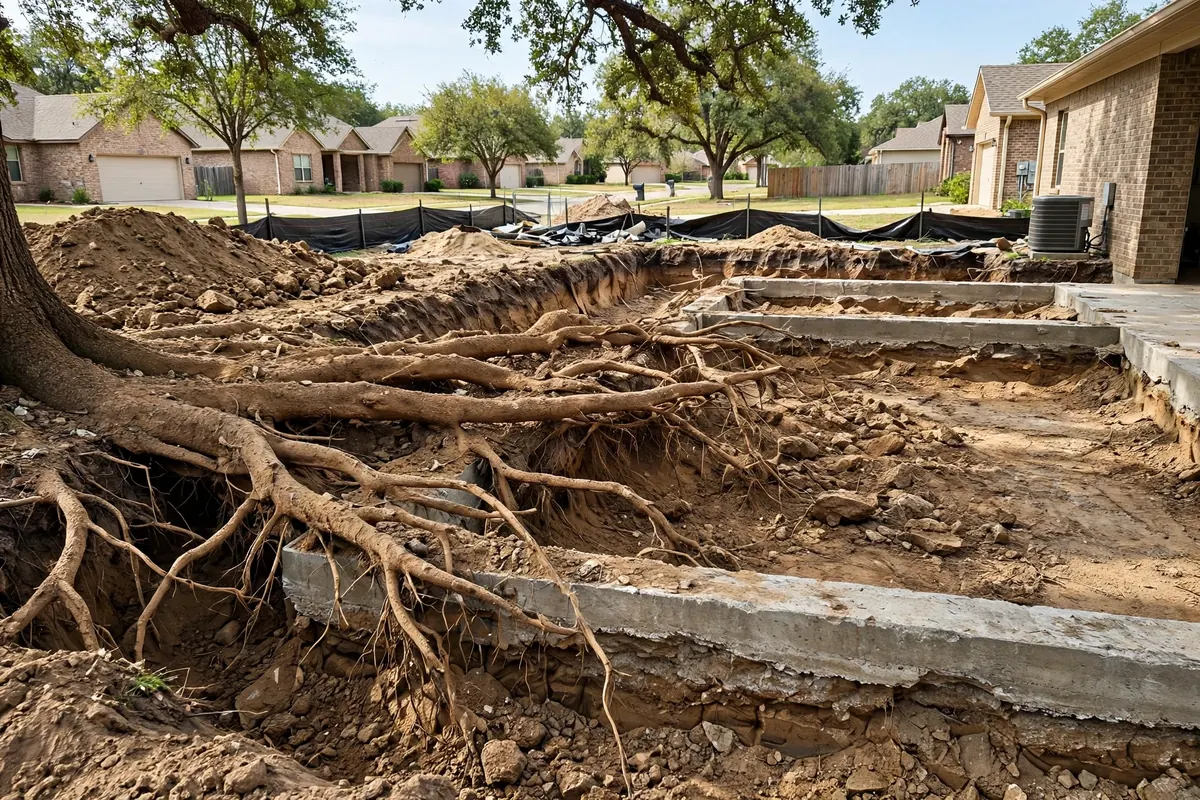
Look at the ground as well. Soil that pulls away from the foundation in a gap on the tree side during a dry spell, while the other sides stay in contact with the wall, shows where the moisture is going. Exposed roots near the surface on the house side of the tree are another clue, because surface roots spread toward the moisture under the slab edge. Inside, a gap that opens between a baseboard and the floor on the tree side, or a window that binds in its frame only in late summer, adds to the picture. None of these signs alone proves the tree is the cause, and that is why readings matter: elevation measurements across the floor show whether the low point sits under the canopy.
Some trees are more likely culprits than others. Large oaks, pecans, and elms with broad canopies draw the most water, and a tree planted close to the house when it was small becomes a much bigger draw as it matures. A tree that was harmless twenty years ago can become the main moisture problem as its canopy spreads over the roof. If the house also shows signs that fit a wider problem, such as cracks on all sides or a slab that has settled evenly, the cause may be the clay itself rather than one tree, and a concrete slab foundation repair plan may be the right answer instead of, or alongside, a barrier. Our guide to tree roots and foundations in Plano explains how to read the pattern before any trench is dug. The same tree patterns show up in Frisco, TX, where new neighborhoods were planted with fast-growing shade trees close to the house.
A tree you love can still dry out one corner
The fix keeps the tree and protects the house. A barrier guides the roots deeper instead of cutting the tree down.
Our process on your home for a root barrier
A barrier is a digging job, and the digging is planned before the first shovel so utilities, roots, and the lawn are all handled properly.
The visit starts with the tree and the house together. We measure the distance from the trunk to the foundation, note the canopy spread, and take floor elevation readings to confirm the low point sits on the tree side. Then we check what lies between the tree and the house: utility lines, sprinkler pipes, irrigation heads, and any hardscape the trench would cross. Underground lines are located before digging, and the trench line is marked on the lawn so the homeowner can see exactly where the work will run.
Digging is done by hand near the tree and near the house, because a machine bucket can tear the roots it is meant to guide and can nick a pipe. The trench is dug to the planned depth in one continuous run, and the panels are set as the trench opens, so the walls do not dry out and crumble before the barrier is in. Each panel overlaps the next with no gap, and the seams are checked from above before backfill. Roots that cross the trench line are cut cleanly at the panel face rather than torn, which helps the tree seal the cut and send new growth downward along the panel.
Backfill is done in layers, with each layer compacted before the next goes in, so the trench does not sink into a visible line across the lawn after the first rain. The surface is restored with the soil that came out of the trench, and the lawn is left level. We walk the line with the homeowner at the end and show the top edge of the panels, the restored surface, and any root that was cut. If the foundation has already moved, the barrier stops further root-driven movement, but it does not lift the house back: that is a separate job, and a steel pier installation plan is discussed when the readings show the foundation needs support as well as protection.
Map the tree and the low point
Canopy, distance, and floor readings confirm the movement lines up with the tree.
Locate what lies between
Utility lines, sprinklers, and hardscape are marked before any digging.
Dig by hand
The trench opens in a continuous run, dug carefully near roots and pipes.
Set the panels
Rigid panels join with no gaps, and roots crossing the line are cut cleanly.
Backfill in layers
Soil goes back in compacted layers so the trench line does not sink later.
Walk the line
A final walkthrough shows the panel edge, the restored lawn, and the plan for watering.
What affects the scope of a root barrier job
Two barriers can look alike on the surface and differ a lot underground. These are the factors that set the scope.
Tree size sets the depth and length. A mature oak with a canopy forty feet across needs a longer and deeper panel than a young ornamental tree, because its feeder roots spread further and draw more water. Distance matters just as much: a tree ten feet from the wall needs a barrier that starts closer to the house, while a tree thirty feet away may need a longer run to catch the roots that travel toward the moisture under the slab. The species matters too, because some trees send roots deeper naturally and others spread wide near the surface, and the panel depth follows the root habit rather than a standard number.
What lies in the ground sets the second half of the scope. A trench that crosses a gas line, a water line, a sprinkler main, or a French drain needs hand digging and careful panel cuts around each crossing, and each crossing adds time. Hardscape adds more: a barrier that runs under a driveway or a patio needs the surface lifted and restored, and a barrier that runs through a bed of mature shrubs needs those plants moved and replanted. Soil that is wet and heavy digs slowly; soil that is dry and hard in summer needs water the day before so the trench walls hold their shape.
The foundation itself is the third factor. A barrier stops further root-driven movement, but a foundation that has already dropped may also need lifting, and a slab that has cracked may need foundation crack repair after the barrier is in. The order matters: the barrier goes in first, the soil moisture evens out over the following season, and any lifting is planned after the ground has had time to respond. Watering after installation also matters. A soaker hose on the house side of the barrier during the first dry season helps the clay rehydrate evenly, and the City of Plano publishes watering guidance for dry spells that we point homeowners toward at plano.gov. Our guide on watering a foundation in Plano explains how even moisture helps after a barrier goes in.
Cracks only on the tree side tell a story
Elevation readings show whether the low point sits under the canopy. One visit answers it.
Questions about root barriers in Plano
Straight answers on trees, barriers, watering, and what a barrier cannot undo.
Will a root barrier harm my tree?
No, when it is planned for the tree. The panel guides roots downward to deeper soil where they still reach water, and roots that cross the trench are cut cleanly so the tree can seal them. The canopy is not cut back for a barrier, and the tree keeps its full crown.
How deep does a root barrier go?
The depth follows the tree and the soil, not a fixed number. Mature oaks and pecans need a deeper panel than young ornamental trees, because their feeder roots reach further down. The planned depth is set after measuring the tree and the distance to the house.
Can a root barrier fix cracks that are already there?
A barrier stops further root-driven movement, but it does not lift a foundation back or close a crack. Cracks that are already open are sealed and monitored after the barrier is in, and any lifting is planned as a separate step once the soil moisture has evened out.
Do I need to remove the tree instead?
Removal is rarely the first answer. A barrier keeps the tree and protects the house, and removal leaves a different problem: the soil where the roots used to drink stays wet and can swell. When a tree is dead, diseased, or too close to the structure to manage, removal is discussed honestly.
How long does installation take?
Most residential barriers finish within a few days, with hand digging near the tree and the house. The time depends on the length of the run, the depth, and what the trench crosses, such as utility lines or hardscape that must be lifted and restored.
Should I water differently after a barrier goes in?
Yes, on the house side of the panel. A soaker hose run on a steady schedule during the first dry season helps the clay rehydrate evenly now that the tree is no longer pulling from that side. The goal is even moisture, not soaked ground.
Questions we hear beside the big oak
Short answers to the things homeowners ask while we mark the trench line.
Can a barrier go in without digging up my whole yard?
Yes. The trench runs in a single line between the tree and the house, not across the whole yard. The lawn over the trench is restored with the same soil, and the line is the only ground that is disturbed.
What if two trees are pulling from the same corner?
The barrier line is planned for both trees, with the panel run extended to cover the roots from each canopy. The readings show which side the low point sits on, and the panel follows that line. Watering on that side should stay even too, so the clay does not dry faster near one tree than near the other.
Will the barrier stop all foundation movement?
It stops root-driven movement. Clay soil still swells and shrinks with rain and drought, and drainage still matters. A barrier is one part of keeping moisture even around the house, alongside grading and downspouts. Check the barrier line once a year for gaps or roots that have grown over the top, and keep the soil graded away from the wall.
Work that often follows a root barrier
Once the roots are guided deeper, the house may still need readings, sealing, or support.
Keep the tree. Guard the corner it dries out.
A root barrier is a quiet fix: one trench, one panel line, and a tree that keeps growing while the soil under the house stays evenly moist. Start with readings that show the pattern, then decide.
Book a Foundation Inspection