Plano foundations crack because the clay under them never sits still. Blackland Prairie clay, the dark, heavy soil under most of the city, soaks up water and swells, then dries out and shrinks, and each swing pushes and pulls on the concrete above it.
By Plano Foundation Repair · Last updated November 24, 2026
Over years of wet springs and dry summers, that push and pull opens cracks in brick, drywall, and slabs, and it lifts one part of a house while another part settles. This guide explains how the soil works, why some homes feel it more than others, and what homeowners can do to keep the ground under their house steadier.
The Texas A&M AgriLife Extension Service publishes guidance on managing expansive clay soils around a home, including watering and grading habits.
Blackland Prairie clay swells when wet and shrinks when dry
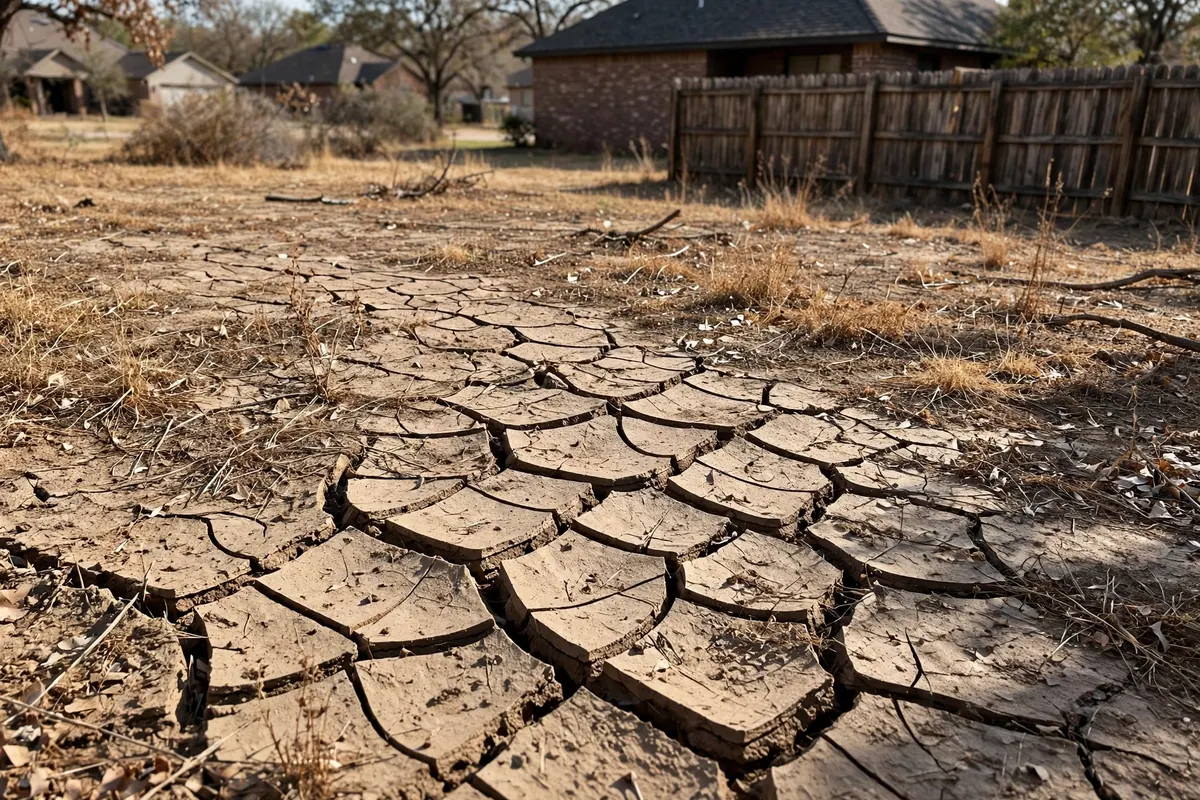
The soil under Plano is a dark clay known as Blackland Prairie clay, and its defining habit is movement. Clay particles are flat and thin, so they stack tightly and hold a lot of water between them. When rain soaks the ground, the particles take in water and the soil swells upward, sometimes lifting the soil by inches across a yard. When a dry spell follows, the water leaves, the particles draw together, and the soil shrinks and cracks open at the surface.
That cycle is normal for this soil, and it has shaped how houses in North Texas are built. Slabs are poured thick with steel inside them, and pier and beam homes rest on piers that reach down through the active soil. The trouble starts when the swelling and shrinking is uneven, one side of a house wet while the other side stays dry, or one corner shaded by a big tree while the other bakes in the sun. Uneven movement bends a foundation, and bending is what cracks brick and drywall. What causes foundation problems in Collin County looks at the other forces that add to the clay cycle, and soil stabilization is the work that firms up weak soil under a home.
How seasonal moisture swings move a slab
A North Texas year runs through a clear moisture rhythm. Spring rains soak the clay and swell it, summer heat dries the top layers and shrinks them, and fall brings a partial recovery before winter. A slab home rides that rhythm, rising a little in the wet months and settling a little in the dry months, and most years the movement is small enough that the house absorbs it without visible damage.
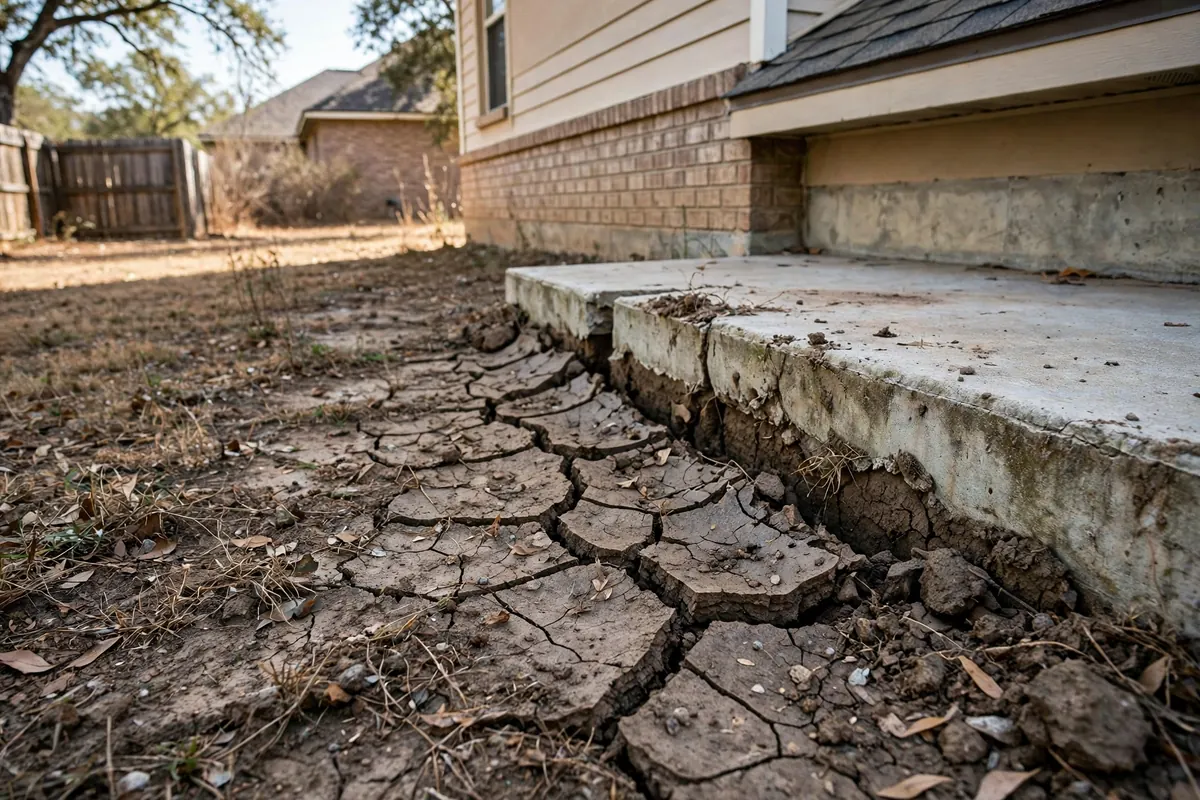
The damage comes when the rhythm gets extreme. A long drought dries the clay deep under a slab, and the soil pulls away from the concrete edge, leaving a gap you can sometimes see along the foundation. A wet winter after a dry summer swells the soil fast under one side of the house while the other side is still dry, and the slab bends between the two. The bend shows up as a stair-step crack in brick, a door that sticks on the wet side, or a floor that slopes toward the dry side. The U.S. Geological Survey publishes plain-language material on expansive soils and the way they move, which is worth a read if you want the science behind the cycle.
Trees make the rhythm stronger. A large oak near a house drinks hundreds of gallons of water from the soil in a dry week, and the clay under that side of the house shrinks faster than the clay on the other side. That is why homes with big trees close to the foundation often show their first cracks on the tree side. Tree roots and your foundation covers that pattern in full, including the root barriers that keep roots and moisture in balance.
How the clay cycle moves through a Plano year
Season
Soil moisture
What the clay does
What you may see
Spring rains
High
Swells and lifts
Doors ease, small cracks close
Summer heat
Low
Shrinks and pulls away
Gaps at the foundation edge
Dry drought spell
Very low
Shrinks deep under the slab
Sticking doors, new cracks
Wet winter
Rising
Swells fast, often unevenly
Cracks widen on one side
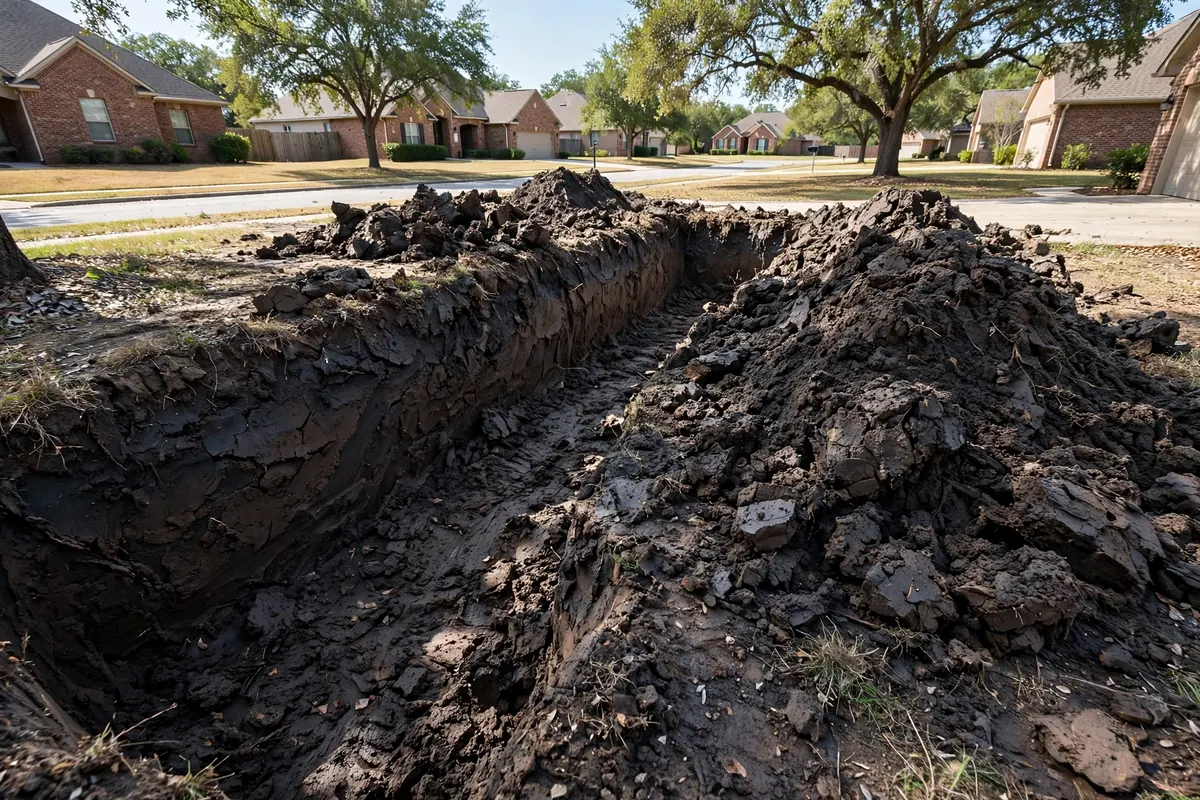
A closer look. Dark heavy clay soil exposed in an excavation beside a foundation.
Why some Plano streets show more trouble than others
Not every Plano street sits on the same soil. The city was built out over decades, and the ground changes from one neighborhood to the next. Older areas near the original town center sit on deep, heavy clay that moves a lot with moisture. Newer subdivisions on the west and north sides of the city were graded and filled during construction, and the fill soil under some of those homes behaves differently from the natural clay around it.
Housing age plays a part too. Homes built in the 1970s and 1980s often sit on slabs poured before current standards for steel and thickness were common, and those slabs bend more easily under uneven soil. Pier and beam homes, common in some of the older neighborhoods, react differently again, because a pier that settles a half inch can tilt a whole room. The age of the house, the soil under it, and the trees around it combine into a risk picture that is different on every street, which is why a neighbor with no trouble at all can live next door to a house with three cracks. Foundation repair in Allen, TX and foundation repair in Richardson, TX show how the same clay behaves in the towns around Plano.
Drainage history across Plano streets
Drainage history matters as well. A street where the lots drain well and the gutters run clear will see steadier soil than a street where water pools against foundations after every storm. When you look at a neighborhood, the houses with the most foundation trouble are often the ones where water has been working against the soil for years.
Not sure what you are seeing?
An inspection measures the floors and the brick, so you get readings and a written plan instead of guesses. Call (972) 430-3826 or book an inspection.
What builders did right, and where soil still wins
Plano builders have known about the clay for decades, and the standard practices are built around it. Slabs are poured with steel reinforcement so they can flex a little without snapping, and the concrete is thicker at the edges where the load is greatest. Pier and beam homes use concrete piers that reach below the soil layer that moves most, so the house rests on steadier ground. Grading rules call for soil to slope away from the house so rainwater runs off instead of soaking in beside the foundation.
Those practices hold up well when the soil moisture stays even, and they are the reason most Plano homes never need foundation work. Where soil still wins is at the edges of the system: a downspout that dumps water beside a corner, a flower bed that gets watered daily on one side while the other side dries out, a tree that grows large over twenty years and starts drinking from soil the builder never planned around. The foundation itself is rarely the weak point. The weak point is usually the moisture around it. Drainage correction fixes the water patterns that let the clay swing, and concrete slab foundation repair is the work that steadies a slab after the soil has moved it.
That is also why a repair that ignores the soil often does not hold. Piers can lift a slab back toward level, but if the water pattern that moved it stays the same, the clay will keep pushing. A good repair plan looks at the soil and the water first, then at the concrete.
What it looks like. Cracked dry earth pulling away from a concrete foundation edge.
Keeping soil moisture steadier around your home
You cannot stop clay from moving, but you can narrow the swings, and narrower swings mean less stress on the foundation. The goal is even moisture around the whole perimeter of the house, not wet soil and not dry soil, just steady soil. Water the ground around the foundation during long dry spells, evenly on all sides, so one side never shrinks far ahead of the other. A soaker hose laid a foot or two from the foundation, run on a slow schedule, is the usual tool, and it works best when it runs before the soil cracks open, not after.
Keep gutters clean and downspouts pointed away from the house, and check that the soil still slopes away from the foundation after a few years of settling. Soil beside a house tends to sink over time, and a low spot beside the wall becomes a pool after every rain. Add soil to the low spots and keep the slope, and keep flower beds and mulch from holding water against the brick. Should you water your foundation in Plano? answers the watering question in detail, and drought and foundation damage in Plano covers what to watch during a dry summer.
Walk the perimeter of your house once a season and look for the gap between dry soil and the foundation edge. A thin gap after a hot week is normal, and a wide gap that runs the length of a wall is a sign the soil is drying faster than you are watering it. That walk takes ten minutes and it catches the clay cycle before it turns into a crack.
More questions, answered plainly
Plain answers to the questions Plano homeowners ask us most about this topic.
?
Is all of Plano built on the same clay?
Most of Plano sits on Blackland Prairie clay, but the depth and behavior of the soil change from one neighborhood to the next. Fill soil in newer subdivisions and the ground near creeks can behave differently from the deep natural clay in older areas.
?
Can clay soil be fixed so it stops moving?
Clay cannot be made to stop moving entirely, but its swings can be narrowed with steady watering, good drainage, and, where needed, soil stabilization work. The aim is even moisture around the house, not a soil that never changes. Piers help, but the soil around them still needs steady moisture to stay even.
?
Do pier and beam homes suffer less from clay?
Pier and beam homes react differently rather than less. Their piers reach below the most active soil, which helps, but a pier that settles or a beam that shifts can still tilt floors and jam doors. Both foundation types need the same steady moisture habits.
?
Does the clay under Plano behave the same in every neighborhood?
No. The clay is the same soil across town, but its depth and the amount of fill over it change from one subdivision to the next. Older streets with mature trees dry out faster on the tree side, while newer graded lots settle as their fill compacts. That is why two homes a mile apart can show very different signs.
Related guides
More reading on the same ground, written for Plano homeowners.